Stop losses: where to put them
A stop loss is a price, set before the trade, where you get out if you're wrong. Put it where your reason for the trade stops being true, like just below the support you bought, not at a random number you can stomach.
Stops aren't perfect: price can jump past one in a gap or crash, and stops set too tight get hit by normal wiggles. Leave a little room beyond the level.
Decide your exit before you enter
A stop loss is a price, set before the trade, where you get out if you're wrong. It turns 'I hope it comes back' into a plan.
Put it where the idea breaks
Place the stop where your reason for the trade stops being true, like just below the support you bought. Not at a random 'I can stomach this' number.
You buy at 100.0 after a bounce off support at 98.0. Where does a logical stop go?
- 99.9: as tight as possible
- A little below 98.0, like 97.6, where the support idea fails
- No stop: support will hold
Show the answer
B. A little below 98.0, like 97.6, where the support idea fails Below support is where you're proven wrong. A stop at 99.9 gets hit by normal wiggles. No stop at all means one bad trade can do huge damage.
Stops aren't perfect
Price can jump past a stop in a gap or a fast crash, and you get filled worse than planned. Stops set too tight get hit by normal wiggles. Leave a little room beyond the level.
A stock closes at 99.9. Your stop is at 98.0. Next morning it opens at 96.4. Roughly where does your stop sell?
- Exactly 98.0
- Near 96.4, the first price available
- It doesn't sell at all
Show the answer
B. Near 96.4, the first price available A standard stop turns into a market order once price reaches it, and fills at the next available price. A gap can skip right over your level.
Your trade is closing in on your stop. What's the disciplined move?
- Move the stop further away to give it room
- Buy more to lower your average price
- Let the stop do its job
Show the answer
C. Let the stop do its job The stop was set when you were calm. Moving it mid-trade is how a planned 1% loss turns into 10%.
Now try it on real charts
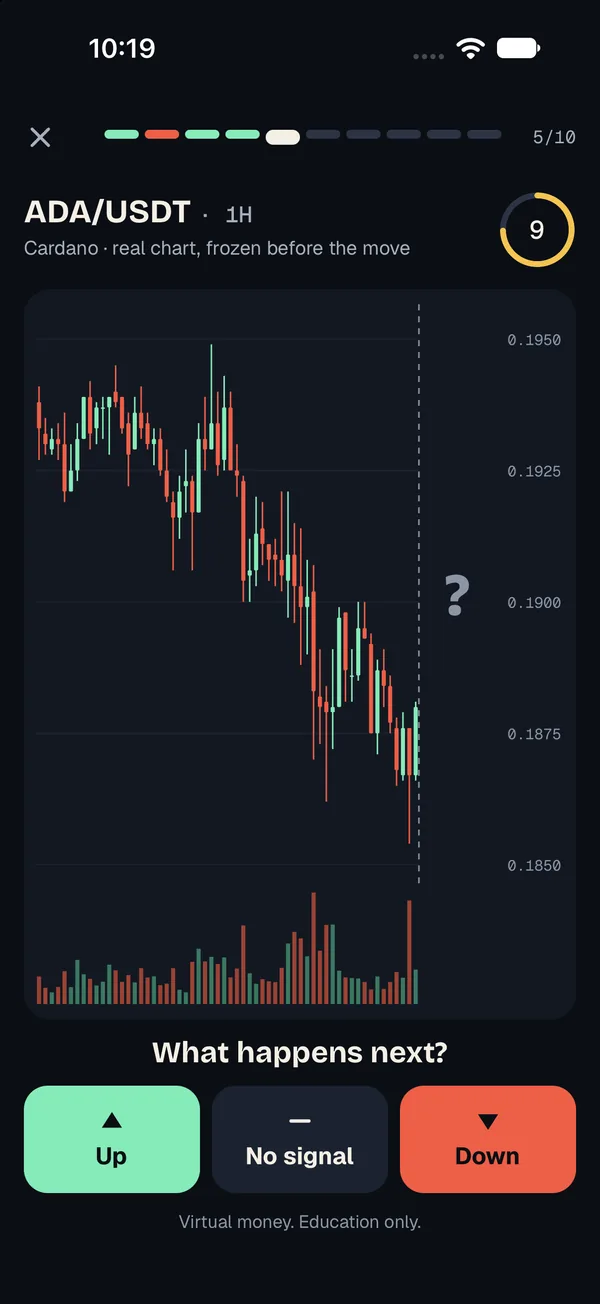
Guides teach the shape. Real charts teach the judgement. In Upwick you call 10 real crypto charts a day and see what happened next.
Coming soon on theApp StoreFree on iPhone. Virtual money only.
FAQ
How far should a stop loss be?
Far enough that normal noise doesn't hit it, placed just beyond the level that would prove your idea wrong. Then size the position so that distance only costs a small slice of your account.
Related lessons
Education only, not financial advice. Patterns describe what often happened before; they don't predict what will happen next.