Risk/reward: the break-even math
Risk/reward compares what you could lose (entry to stop) with what you aim to make (entry to target). Risking $2 to aim for $6 is 1:3.
At 1:2, winning 1 trade in 3 breaks even before fees; at 1:1 you need to win more than half once fees count. But a 1:5 target that runs through heavy resistance is fantasy math.
Risk vs reward
Risk/reward compares what you could lose (entry to stop) with what you're aiming to make (entry to target). Risking $2 to aim for $6 is 1:3.
Entry 100, stop 98, target 106. What's the risk/reward?
- 1:2
- 1:3
- 1:6
Show the answer
B. 1:3 Risk = 100 − 98 = 2. Reward = 106 − 100 = 6. 2 to 6 is 1:3.
The break-even math
At 1:2, winning 1 trade in 3 breaks even, before fees. At 1:1, you need to win more than half once fees count. Better risk/reward gives you room to be wrong.
If every trade has a 1:2 risk/reward, what win rate breaks even before fees?
- 50%
- About 33%
- About 67%
Show the answer
B. About 33% Win 1, lose 2: +2 − 1 − 1 = 0. One win in three, about 33%, breaks even. Fees push the real number a bit higher.
Targets must be real
A 1:5 target that runs straight through heavy resistance is fantasy math. Set targets at levels price can realistically reach, and skip trades where the honest numbers are poor.
Entry 100, stop 98, target 106, but strong resistance sits at 102. What's the more honest view?
- It's 1:3; resistance doesn't affect risk/reward
- The realistic risk/reward is closer to 1:1, since price may stall at 102
- Move the stop to 99.5 so the numbers look better
Show the answer
B. The realistic risk/reward is closer to 1:1, since price may stall at 102 If 102 is where price is likely to stall, that's the realistic target: 2 of reward for 2 of risk. Moving the stop just to improve the ratio puts it where the idea isn't wrong yet.
Now try it on real charts
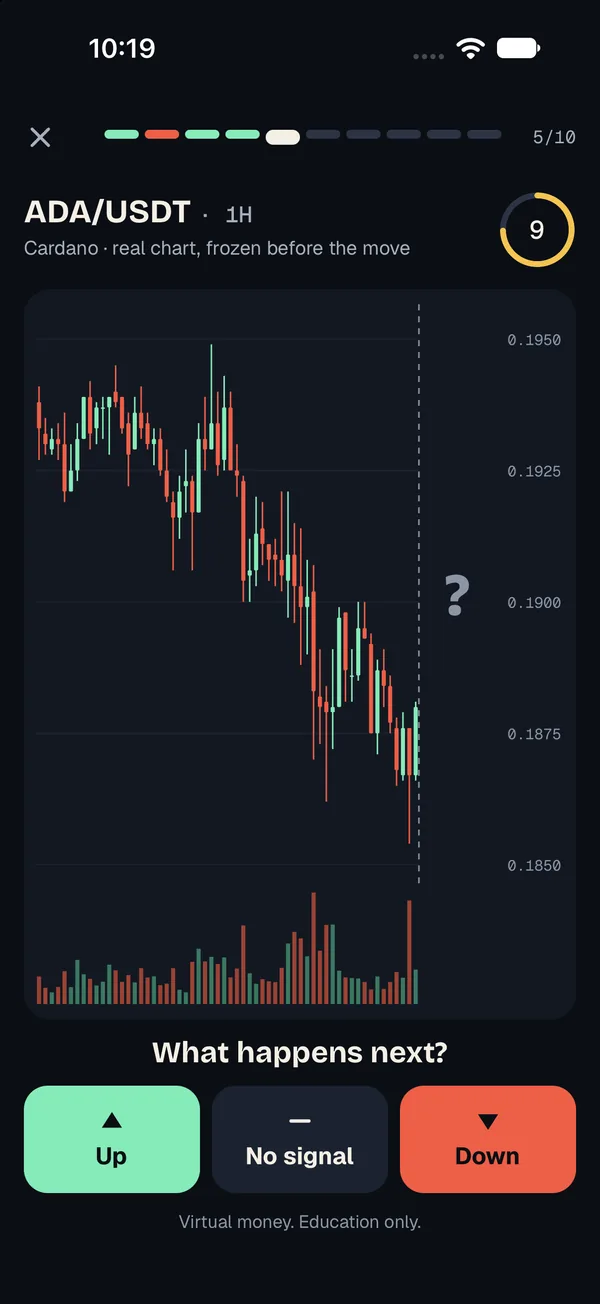
Guides teach the shape. Real charts teach the judgement. In Upwick you call 10 real crypto charts a day and see what happened next.
Coming soon on theApp StoreFree on iPhone. Virtual money only.
FAQ
What is a good risk reward ratio?
Many traders look for at least 1:2, because it leaves room to be wrong more often than right. But the target has to be realistic: a big ratio with an unreachable target is worse than a modest one.
Related lessons
Education only, not financial advice. Patterns describe what often happened before; they don't predict what will happen next.