Position sizing: the 1% rule
Pick your position size so that if your stop is hit you lose a small, fixed slice of your account. Many traders risk at most 1% per trade: with $10,000, that's $100.
Worked example: buy at $100 with a stop at $98, so $2 at risk per share. $100 ÷ $2 = 50 shares, a $5,000 position whose planned loss is still $100. Stop first, size second.
Size by risk, not vibes
Position size is how much you buy. Pick it so that if your stop gets hit, you lose a small, fixed slice of your account. Stop first, size second.
The 1% rule
Many traders risk at most 1% of their account per trade. With $10,000, that's $100. Ten losses in a row would cost just under 10%: painful, but survivable.
Worked example
$10,000 account, 1% risk = $100. Buy at $100, stop at $98: $2 at risk per share. $100 ÷ $2 = 50 shares. That's a $5,000 position, but your planned loss is still $100.
Account $5,000, risking 1%. Entry $100, stop $95. How many shares?
- 50
- 10
- 1
Show the answer
B. 10 1% of $5,000 = $50. Risk per share = $100 − $95 = $5. $50 ÷ $5 = 10 shares.
Same $5,000 account and 1% risk, but a tighter stop: entry $100, stop $98. How many shares now?
- 10
- 50
- 25
Show the answer
C. 25 $50 ÷ $2 = 25 shares. Tighter stop, bigger position, same $50 at risk. The stop distance sets the size, not the other way round.
Why risk 1% per trade instead of 25%?
- So a normal losing streak can't wipe out your account
- Because 1% trades win more often
- Because brokers don't allow more
Show the answer
A. So a normal losing streak can't wipe out your account Four 25% losses in a row leave about 32% of your account. Four 1% losses leave about 96%. Losing streaks happen to everyone.
Now try it on real charts
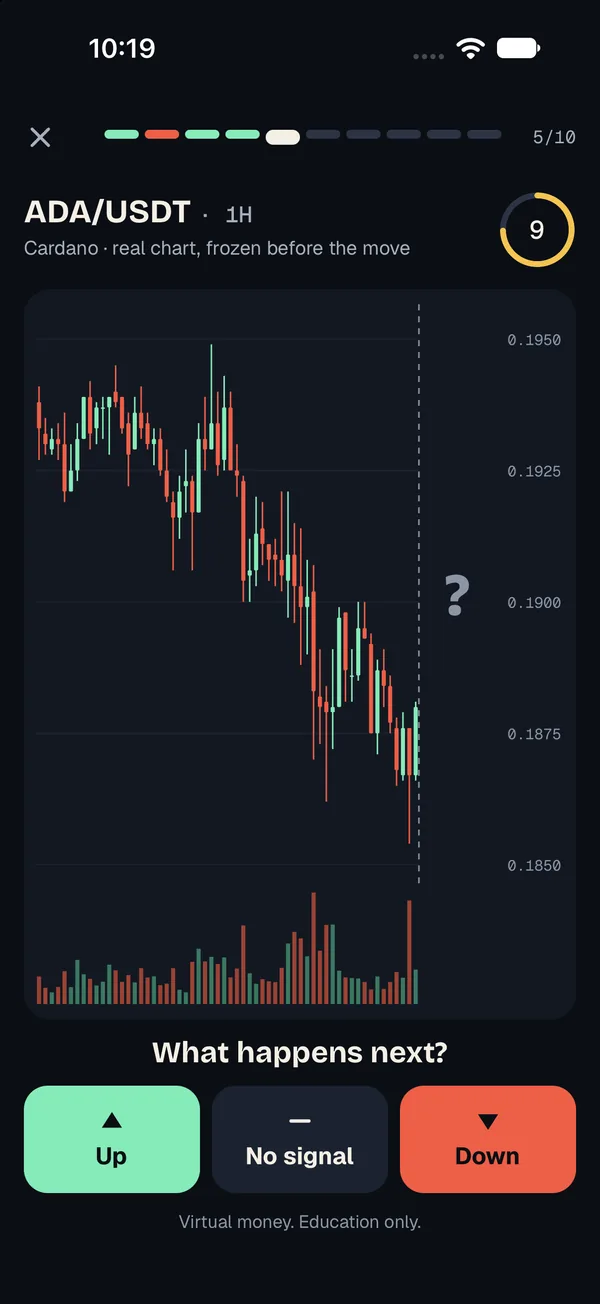
Guides teach the shape. Real charts teach the judgement. In Upwick you call 10 real crypto charts a day and see what happened next.
Coming soon on theApp StoreFree on iPhone. Virtual money only.
FAQ
How do you calculate position size?
Position size = amount you're willing to risk ÷ distance from entry to stop. Risking $100 with a $2 stop distance gives 50 shares.
Why risk only 1% per trade?
Because losing streaks happen. At 1% risk, ten losses in a row cost just under 10% of the account: painful but survivable.
Related lessons
Education only, not financial advice. Patterns describe what often happened before; they don't predict what will happen next.