What volume tells you on a chart
Volume counts how many shares or coins traded during a candle, usually shown as bars under the price. A big move on big volume means many traders took part; a big move on thin volume means few did, and such moves can reverse more easily.
Volume only means something relative to its usual level, so traders compare it with the average of recent candles, often the last 20.
How much changed hands
Volume counts how many shares or coins traded during a candle. Full charts usually show it as bars under the price. Taller bar, more trading.
Volume = participation
A big move on big volume means lots of traders took part. A big move on thin volume means few did, and moves with little participation can reverse more easily.
Always compare to normal
Volume only means something relative to its usual level. A million might be huge for one market and tiny for another. Traders compare it with the average of recent candles, often the last 20.
A candle traded 500,000. The 20-candle average is 2,000,000. How would you describe its volume?
- High: half a million is a lot
- Low: about a quarter of normal
- Impossible to say
Show the answer
B. Low: about a quarter of normal 500,000 ÷ 2,000,000 = 0.25. Volume is only big or small compared with that market's normal.
Two identical green candles. A traded 3× the average volume, B traded half the average. Which shows more participation?
- A
- B
- Same: the candles look identical
Show the answer
A. A Same shape, different crowd. A had six times as much trading behind it as B.
Now try it on real charts
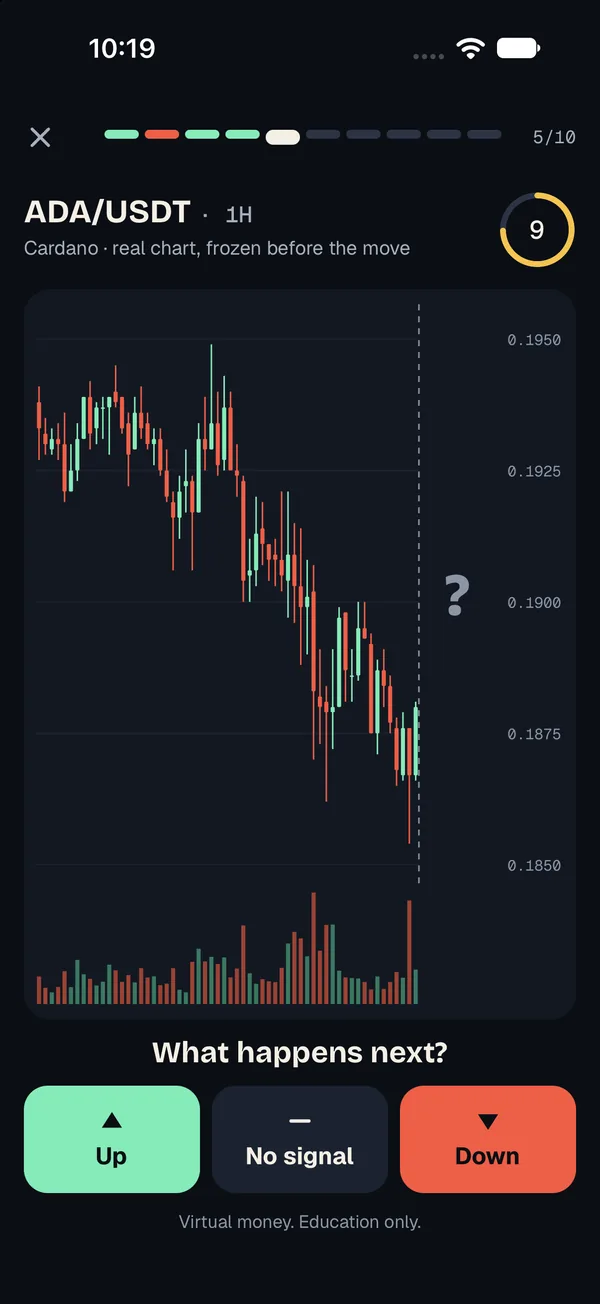
Guides teach the shape. Real charts teach the judgement. In Upwick you call 10 real crypto charts a day and see what happened next.
Coming soon on theApp StoreFree on iPhone. Virtual money only.
FAQ
What is high volume in trading?
There's no absolute number. Volume is high when it's well above that market's recent average, for example two or three times the 20-candle average.
Related lessons
Education only, not financial advice. Patterns describe what often happened before; they don't predict what will happen next.