Volume and breakouts
A breakout on volume well above average shows many traders acting at the level; low-volume breakouts get more suspicion. Volume often shrinks while price coils in a range or flag, then jumps on the break.
In crypto each exchange reports its own volume, so one chart only shows part of the market. Either way, volume is a clue to weigh, not a verdict.
Breakouts need fuel
A breakout on volume well above average shows many traders acting at the level. Low-volume breakouts get more suspicion, since fewer participants are backing the move.
Quiet coil, loud break
Volume often shrinks while price drifts in a range or flag, then jumps when it breaks out. That squeeze-then-release is a classic picture.
Which breakout has the most confirmation?
- Pokes above resistance with a wick, on 0.6× average volume
- Closes above resistance on 0.5× average volume
- Closes above resistance on 2.5× average volume
Show the answer
C. Closes above resistance on 2.5× average volume A close beyond the level plus heavy participation: two filters passed. A wick alone isn't a breakout, and a close on thin volume has less behind it.
A breakout closes above resistance on 3× average volume. Which is true?
- It can't fail now
- It's a stronger sign, but it can still fail
- Volume doesn't matter for breakouts
Show the answer
B. It's a stronger sign, but it can still fail Heavy volume improves the picture; it doesn't guarantee anything. The stop still goes back inside the old range.
Know what you're looking at
In crypto, each exchange reports its own volume, so one chart only shows part of the market. Stock charts usually combine all exchanges. Either way, volume is a clue to weigh, not a verdict.
Now try it on real charts
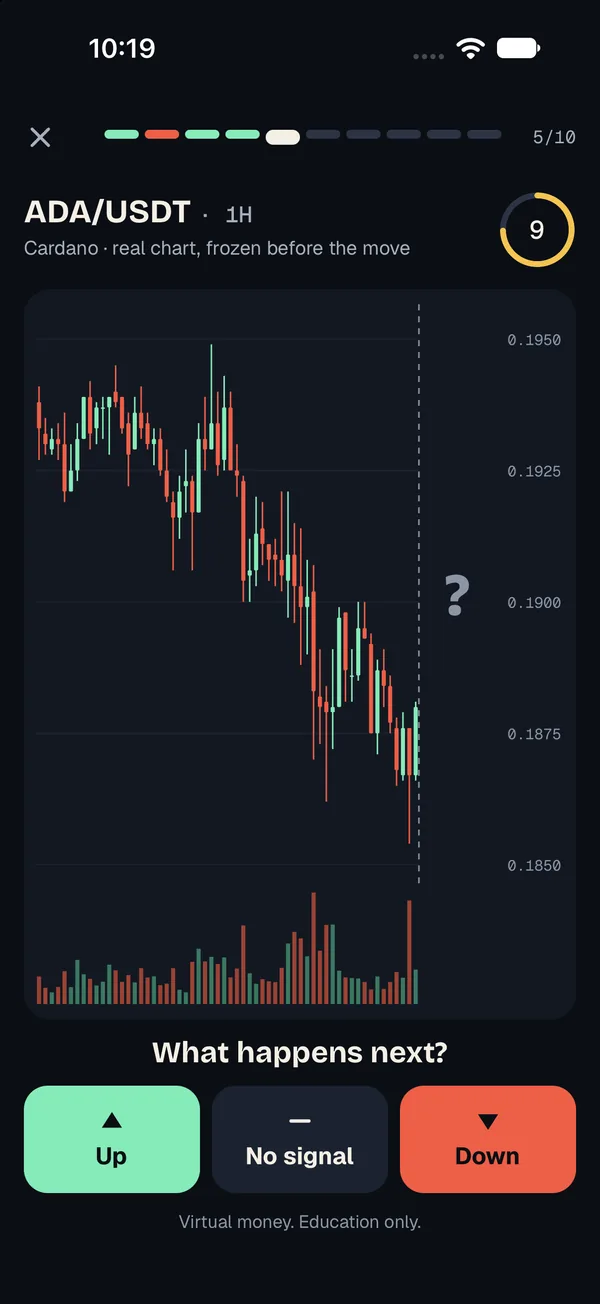
Guides teach the shape. Real charts teach the judgement. In Upwick you call 10 real crypto charts a day and see what happened next.
Coming soon on theApp StoreFree on iPhone. Virtual money only.
FAQ
Can a breakout succeed on low volume?
Yes, it happens. Low volume just means fewer participants are backing the move, so traders treat it with more suspicion.
Related lessons
Education only, not financial advice. Patterns describe what often happened before; they don't predict what will happen next.