Triangle patterns: ascending, descending and symmetrical
A triangle forms when price swings get smaller and smaller, coiling into a tighter range. Ascending triangles have a flat top and rising lows, descending ones a flat bottom and falling highs, symmetrical ones squeeze from both sides.
Ascending triangles are usually read as bullish and descending ones as bearish, but either can break the 'wrong' way. Wait for a close outside the pattern.
The squeeze
A triangle forms when price swings get smaller and smaller. The range is coiling, and a breakout often follows once one side gives up.
Three flavors
Ascending: flat top, rising lows. Descending: flat bottom, falling highs. Symmetrical: falling highs and rising lows squeezing toward each other.
Flat top at 103, and each dip stops higher than the last. Which triangle is this?
- Descending triangle
- Symmetrical triangle
- Ascending triangle
Show the answer
C. Ascending triangle Flat ceiling plus rising floor = ascending. Buyers keep stepping in earlier while sellers defend the same price.
No promises on direction
Ascending triangles are usually read as bullish and descending ones as bearish, but either can break the 'wrong' way. Wait for a close outside the pattern.
A descending triangle has a flat bottom at 97. Price just closed at 95.8. What happened?
- A breakdown below the flat bottom
- A breakout to the upside
- Nothing: triangles ignore closes
Show the answer
A. A breakdown below the flat bottom Three tests of 97, falling highs, then a close below 97. The floor gave way.
Does an ascending triangle always break upward?
- Yes, always
- No: it leans bullish, but it can break down too
Show the answer
B. No: it leans bullish, but it can break down too It's a lean, not a rule. That's why traders wait for the close outside the pattern and keep a stop on the other side.
Now try it on real charts
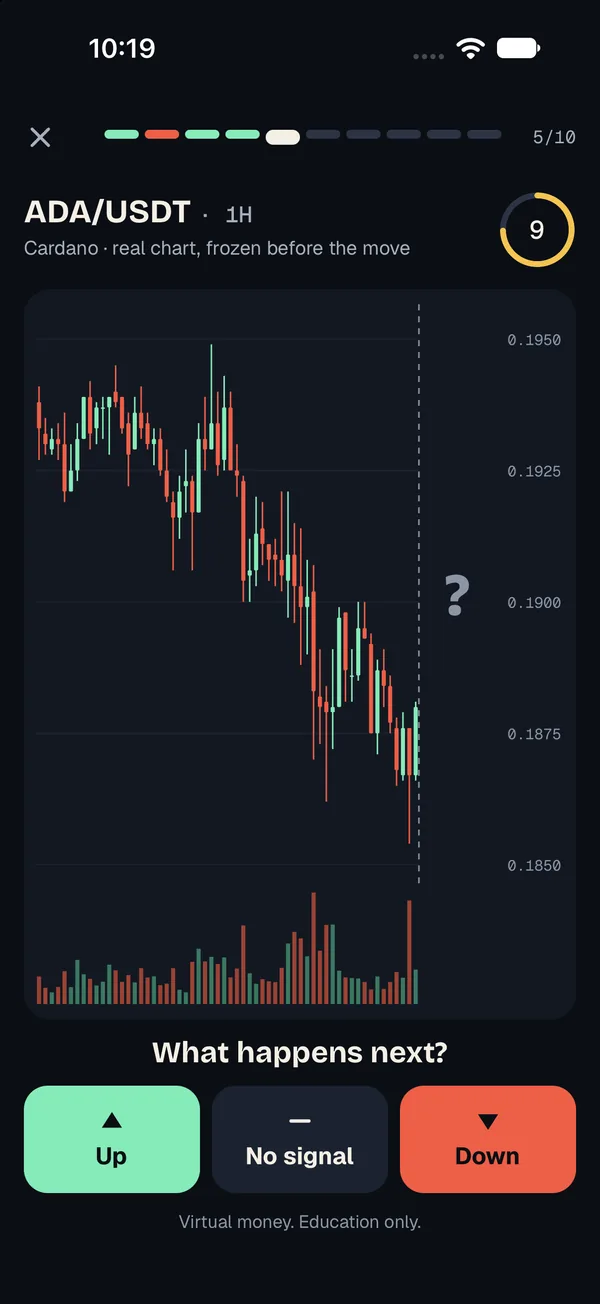
Guides teach the shape. Real charts teach the judgement. In Upwick you call 10 real crypto charts a day and see what happened next.
Coming soon on theApp StoreFree on iPhone. Virtual money only.
FAQ
Is an ascending triangle always bullish?
No. It's usually read as bullish because buyers keep stepping in higher, but it can break down. The close outside the pattern is what counts.
Related lessons
Education only, not financial advice. Patterns describe what often happened before; they don't predict what will happen next.