Role reversal: when old resistance becomes support
When price breaks above resistance and holds, that old ceiling often turns into support. Traders call it a role reversal or flip; it works the other way too, with broken support becoming resistance.
It happens because traders who missed the breakout buy the retest, and traders who bet against it buy back to exit, both right at the old level.
Broken ceiling, new floor
When price breaks above resistance and holds, that old ceiling often turns into support. Traders call it a role reversal, or a flip.
Why it flips
Traders who missed the breakout buy the retest. Traders who bet on a drop and got it wrong buy back to exit. Both add buying right at the old level.
Price broke above 100 and is now pulling back toward it. What role might 100 play now?
- Still resistance
- Support
- None: broken levels stop mattering
Show the answer
B. Support Broken resistance often flips to support. 'Often' is doing work there: if price closes back below 100, the breakout failed.
Works both ways
Broken support often becomes resistance. Price falls through a floor, rallies back up to it, and stalls underneath.
Support at 100 broke. Price has rallied back up to 100 (highlighted). What's the role-reversal read?
- 100 may now act as resistance
- 100 is now guaranteed support
- The breakdown is cancelled because price came back
Show the answer
A. 100 may now act as resistance Old floor, new ceiling. Buyers stuck from above 100 often sell to get out even. Not guaranteed: a strong close back above 100 would undo the read.
Now try it on real charts
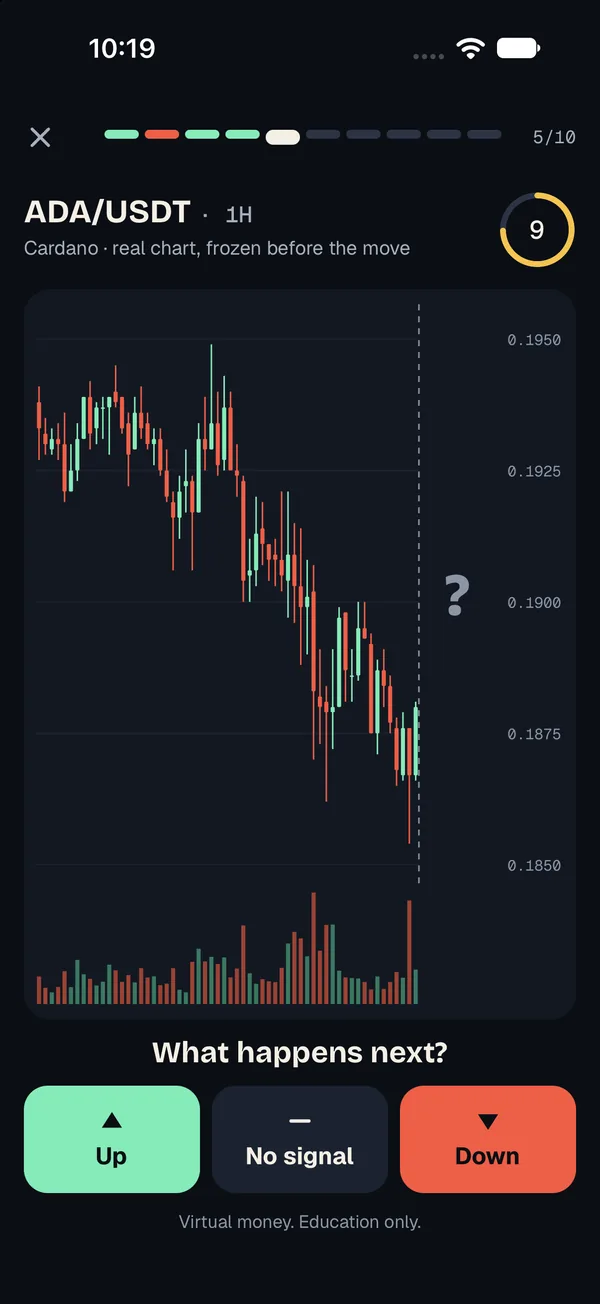
Guides teach the shape. Real charts teach the judgement. In Upwick you call 10 real crypto charts a day and see what happened next.
Coming soon on theApp StoreFree on iPhone. Virtual money only.
FAQ
What is a retest in trading?
After price breaks a level, a retest is when it comes back to touch that level from the other side. A retest that holds is what turns old resistance into support.
Related lessons
Education only, not financial advice. Patterns describe what often happened before; they don't predict what will happen next.