Moving averages: what the 20 MA tells you
A 20-period moving average adds up the last 20 closes and divides by 20, giving a smooth line that trails price. Price mostly above a rising average points to an uptrend; mostly below a falling one, to a downtrend.
Because it's built from past prices, it always lags: good at 'what's the trend?', bad at calling exact turns, and noisy in sideways chop.
The average of the last 20 closes
A 20-period moving average (20 MA) adds up the last 20 closes and divides by 20. With each new candle, the oldest one drops out. The result is a smooth line that trails price.
The last 20 closes add up to 2,040. What's the 20 MA?
- 2,040
- 102
- 20.4
Show the answer
B. 102 2,040 ÷ 20 = 102. That's the point the 20 MA plots for the latest candle.
Use it as a trend filter
Price mostly above a rising 20 MA points to an uptrend. Mostly below a falling one points to a downtrend. Some traders only look for buys above it and sells below it.
Price has stayed above a rising 20 MA for weeks. Under a simple trend-filter rule, which setups do you focus on?
- Buy setups: the trend is up for now
- Sell setups: price is 'too high'
- Any setup: the MA tells you nothing
Show the answer
A. Buy setups: the trend is up for now A trend filter only lets you trade in the trend's direction. It doesn't predict tomorrow; it just keeps you from fighting the main move.
It always lags
An average of past prices trails behind. It's good at 'what's the trend?' and bad at calling exact turns. In sideways chop, price whips back and forth across it.
Why does the 20 MA react late when a trend turns?
- It only updates once a week
- It averages past prices, so it trails behind
- It waits for RSI to confirm
Show the answer
B. It averages past prices, so it trails behind Today's 20 MA still includes closes from 19 candles ago. A sharp turn needs several candles before it moves the average much.
Now try it on real charts
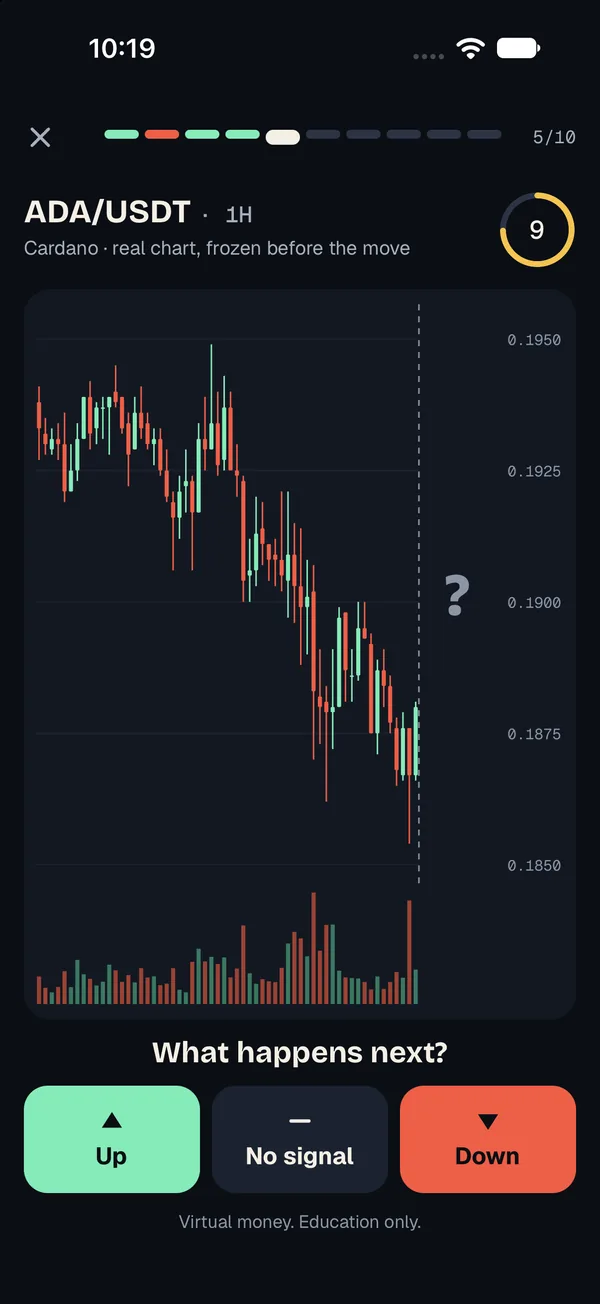
Guides teach the shape. Real charts teach the judgement. In Upwick you call 10 real crypto charts a day and see what happened next.
Coming soon on theApp StoreFree on iPhone. Virtual money only.
FAQ
What is the difference between a simple and an exponential moving average?
A simple moving average weights each of the last N closes equally. An exponential moving average gives more weight to recent closes, so it reacts faster and lags a little less.
Related lessons
Education only, not financial advice. Patterns describe what often happened before; they don't predict what will happen next.